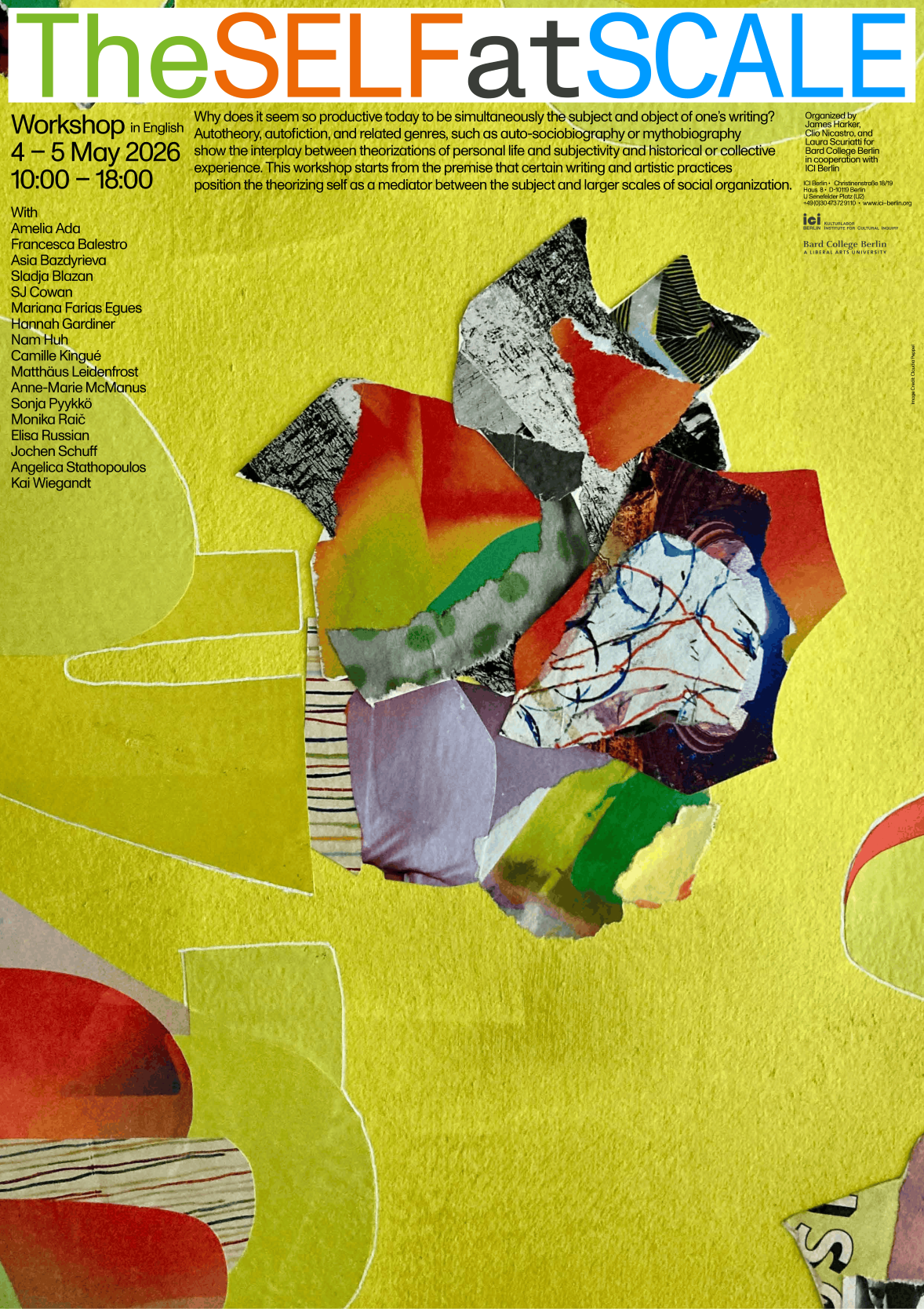
The Self at Scale
Monday, May 4, 2026 – Tuesday, May 5, 2026
ICI Berlin (Christinenstr. 18/19, Haus 8 10119 Berlin)
10:00 am – 6:00 pm CET/GMT+1
Why does it seem so productive today to be simultaneously the subject and object of one’s writing? This workshop starts from the premise that certain writing and artistic practices position the theorizing self as a mediator between the subject and larger scales of social organization. The contemporary fascination with autotheory, autofiction, and related genres, such as auto-sociobiography or mythobiography, is a case in point. These forms show the interplay between theorizations of personal life, subjectivity and historical or collective experience. However, these practices also have their own histories. The workshop is therefore interested in the politics and aesthetics of this interplay, in the genealogies of these forms, and in the moments when these practices have intensified.10:00 am – 6:00 pm CET/GMT+1
The aim of the workshop is to facilitate dialogue between multiple discourses. One such discourse is feminist theory, which has long offered insights into the concept of the theorizing self as mediator. Another discursive resource is the theory and practice of life writing, from the early 20th century onwards. It is precisely within the space between theory and practice, between history and biography, that the ‘unexpected subject’ can emerge (to borrow the term of Italian critic and theorist Carla Lonzi). Such tension has been framed in works of life writing that deliberately play with the implications of this problem, such as Luisa Passerini’s Autoritratto di gruppo (Autobiography of a Generation, 2008), Annie Ernaux’s Les années (The Years, 2008), the collective autobiography Baby Boomers. Vite parallele dagli anni Cinquanta ai cinquant’anni (Baby Boomers: Parallel Lives from the 1950s to One’s Fifties, by Rosi Braidotti, Roberta Mazzanti, Serena Sapegno, and Annamaria Tagliavini, 2003), as well as Carla Lonzi’s seminal Autoritratto (Self-portrait, 2022), published in 1969. In other contexts, and in relation to the problems posed by racialization and more recent developments in the conceptualization of sexuality, authors such as Gloria Anzaldúa, Saidiya Hartman, Sara Ahmed, and Paul B. Preciado, have turned to forms of autotheory to reconsider the relationship between embodied subjectivity, selfhood, and the world. Alongside gender, race, and postcolonial critique, what additional insights could autotheoretical writing offer to a renewed reflection on class, its representations, and its lived contradictions?
In what ways do contemporary practices of autotheory preserve, or intentionally erase, a potential space of freedom? Rather than preemptively reading this genre as a symptom of narcissism and self-referentiality, this question aims to explore the reasons behind its attraction for readers and its global success. Traditionally, the ‘freedom’ of the liberal individual is located in the private spheres of the domestic or inner life. However, in a post-Marxist and post-Foucauldian landscape, such spaces of freedom appear to be possible only through the disavowal of one’s social embeddedness. Feminist and critical instances of the practice of autotheory generally aim to open up or create spaces in which a focus on the self functions as an antidote and an alternative to a multiplicity of discourses connected to power. These discourses include the logocentrism of canonical theoretical discourse, in which the abstraction of theory is seen to cloud or obscure specific subject positions, their histories, and their epistemologies. Some of the questions at the heart of this workshop emerged from conversations with students at Bard College Berlin. It is designed to be accessible to students and will bring together scholars, writers, and artists.
How to Attend:
- At the venue (registration required): Registration opens on 20 April 2026.
- No online attendance / no livestream available (in-person only).
James Harker, Clio Nicastro, and Laura Scuriatti for Bard College Berlin in cooperation with ICI Berlin
Program:
Monday, 4th May
10:00-12:00 Panel I - New Ways of Seeing and Scaling Autofiction and Autotheory
Introduction by James Harker, Clio Nicastro, and Laura Scuriatti
Visions of Community: Negotiating Recognition in Kaoutar Harchi’s Comme nous existons
Elisa Russian
An Attempt to Decolonize Autotheory
Camille Kingué
Embodied Autotheory in Motion: Queer and Diasporic Selfhood in the Moving-Image Practices of River Yuhao Cao and Tuyet Van Huynh
Nam Huh
12:00-13:30 Lunch Break
13:30-15:00 Panel II - Autotheory Within and Against the Institution
The Self at the Scale of Disappearance: Collective Autotheory in Rosa Yassin Hassan’s Negative
Anne-Marie McManus
Mandated Autotheory: Writing the Self at Scale in Brazilian Teacher Education
Mariana Farias Egues
Autotheory as Disorder
Jochen Schuff
15:00-15:30 Coffee Break
15:30-17:30 Panel III- Demands and Refusals of Autotheory and Autofiction
Auto-phenomenology: A Lazy Science
Angelica Stathopoulos
The Business of Dreams: The Demand for Change and the Presumptions of the Self
SJ Cowan
Genres of Refusal: Autofiction and the Trans Body
Amelia Ada
The Scale of (Self-)Recognition in Jorge Luis Borges’ Los espejos velados
Monika Raič
17:30 End of Day Discussion
Tuesday, 5th May
10:00-12:00 Panel IV- Autoforms at the Environmental and Planetary Scale
The Dissolution of the Autotheoretical ‘I’
Sladja Blazan
Writing the Self at Planetary Scale: Autofiction and the Mediation of Climate Change
Francesca Balestro
Becoming Prey: Transforming the Self Through Writing About Animal Encounters
Matthäus Leidenfrost
Spheres of Influence
Asia Bazdyrieva
12:00-14:00 Lunch Break
14:00-16:00 Panel V - Scale, Presence, and Dimensions of Self in Autofiction
The Self at a Loss: Epitaph and/as Autotheory in Anne Carson’s Nox
Sonja Pyykkö
‘There is too much self in my writing’: Anne Carson, Autoforms, and the Self
Hannah Gardiner
Autofictional Commonality: Orality and Challenged Individuality in Rachel Cusk’s Outline Trilogy
Kai Wiegandt
For more information, e-mail [email protected].
Time: 10:00 am – 6:00 pm CET/GMT+1
Location: ICI Berlin (Christinenstr. 18/19, Haus 8 10119 Berlin)